Homeowner’s Insurance: What you need to know


An overview of homeowners insurance:

  • Your Dwelling is covered under your policy and includes your home and structures such as a garages or deck that are attached to your home.
  • Personal Property such as furniture and other contents are typically covered.
  • Other Structures are covered under your policy and include buildings such as a garage or storage shed that are separate from the house.
  • Family Liability Protection helps protect you if someone sues you for damages after being injured on your property.

Actual Cash Value vs. Reimbursement Provision

  • Actual Cash Value typically means your belongings are covered for their replacement cost minus depreciation,. Deprecation is the decrease in the item’s value due to its age, condition or other factors.
  • Reimbursement Provision typically means your belongings are covered for the amount it would take to replace them at the time of the claim. Premiums are usually higher for this coverage. 


Here’s how the Reimbursement Provision works:  

  • At the time of claim filing your insurance company give you a check for the Actual Cash Value of the item.
  • When you replace the item, a check will be issued for the remaining amount needed to make the purchase.

Deductible is your share of the cost. When you file a claim for a covered loss. You may be responsible for a set amount, called a deductible, to repair or replace whatever is damaged or stolen.

  •  Not all coverages will have a deductible. However, a deductible will always apply to Dwelling, Other Structures and Personal Property coverages.
  • The amount of any deductible will be shown on your Policy Declarations next to the coverage.  
  • In most cases, you choose the deductible from a range of options. A higher deductible usually means lower insurance premium.

Need more protection? There are more optional coverages that you may be able to purchase either as add-ons to your policy or as a separate policy. the coverages listed may not be avaialble in all states and limits may vary:

Available as add-ons to a policy: 

  • Extended coverage on jewelry; watches and; increases limits for jewelry, watches and furs
  • Scheduled Personal Property; provides increased limits for personal property such as jewelry, cameras, antiques, recreational equipment and more.
  • Identity theft Restoration; if your identity gets stolen, this coverage can help with legal work, phone calls and lost wages. 
  • Water Backup; Helps cover damage in your home from backed up drains or broken sump pumps.
  • Increased coverages on business property; Protects items you’re keeping in your home as business samples or for sales.

Seprates policies you can purchase:

Flood insurance, your insurance agent can help you purchase a separate policy through the National Flood Insurance Plan

Personal Umbrella Policy; If someone sues you over an accident and the settlement exceeds the liability limits on your auto and/or home insurance, this coverage can help protect your assets.

Insurance information was provided by Nate Bochsler from Allstate Insurance http://www.allstate.com/nbochsler

Kerstin G. Brooks
Brooks & Heinze Team
http://www.propertyinseattle.com
Refinance, Short Sale and Loan Modification


What to do if you are struggling with loan payments or if you want to reduce your payments. What is “Home Loan Assistance”?

Home Loan Assistance can come in different forms such as refinance, short sale and loan modification. Depending on your situation, you may qualify for one or more of these programs.

Traditional Refinance

If you’re current on payments and have equity in your home, a refinance could help you take advantage of today’s low interest rates.

A refinance could help you:

  • Lower your interest rate
  • Save on monthly payments
  • Change the term of the loan
  • Switch from an adjustable rate to a fixed rate
  • Consolidate debt
  • Refinancing fees apply.

Making Home Affordable Refinance (Federal program)

If you can’t take advantage of a traditional refinance, you could qualify for refinancing through the federal government’s Making Home Affordable Program.

You could qualify for a Making Home Affordable refinance if:

  • You have a Fannie Mae or Freddie Mac mortgage loan on your primary residence, second home, or investment property. Please contact Fannie Mae at 1-800-7FANNIE or Freddie Mac at 1-800-FREDDIE if you are unsure.
  • You owe no more on your first mortgage than 105% of your home’s current value. (Example: you owe $105,000 on a home with a current market value of $100,000.).
  • You are current on your existing mortgage.
  • You are interested in a new fixed or adjustable loan at current low rates. Refinancing fees apply.

You can learn more about the federal government’s Making Home Affordable Programs at makinghomeaffordable.gov.

Making Home Affordable Modification (Federal Program)

If you are behind on payments, or are having difficulty making your payments, you could qualify for a free loan modification through the federal government’s Making Home Affordable program.

You could qualify for a Making Home Affordable loan modification if:

  • You own and occupy your home as your primary residence.
  • You are either current, at risk of imminent default, or behind in your mortgage payments, or are in foreclosure or bankruptcy.
  • The unpaid principal balance of the first mortgage on your primary residence is $729,750 or less (loan limits are higher on owner-occupied multi-unit properties).
  • You have verifiable source(s) of income to put towards a mortgage payment each month, even if that income has recently been reduced.
  • You can provide copies of your most recent tax returns and will sign an affidavit of financial hardship.
  • You have not previously modified your mortgage under the Making Home Affordable program.
  • Mortgages on second homes, vacant homes, and investment properties are not eligible for modification under this program.

You can learn more about the federal government’s Making Home Affordable programs at makinghomeaffordable.gov.

Assistance through other programs (such as repayment plans, short sales and modifications)

Repayment Plan

A repayment plan allows you to make a regular payment plus a portion of the amount past due each month over a period of months. This option is based on financial information you provide and you may be required to make a deposit toward the amount past due.

Loan Modification (through your current lender)

This option is commonly used when there has been a temporary reduction in income or an increase in expenses. An effective loan modification could lower your monthly mortgage payment and cure any delinquencies on the account. Contact your mortgage company for details.

Short Sale

Some homeowners having difficulty making their mortgage payments decide their best option is to sell their home. If you decide to sell your home and the market value of your home is less than what you owe on your loan, a short sale could be an option for you.

In a short sale situation, your lender may agree to accept less than the total amount due on the loan to avoid foreclosure.

Things to think about with a short sale:

  • You could be asked to make a contribution to help reduce the total loss.
  • You must list the property for sale at fair market value with a real estate agent who must forward any offers to your lender for consideration.
  • Acceptance of any offer will be subject to bank approval.
  • Your agent’s commission may be limited by your lender.

Deed In Lieu Of Foreclosure (DIL)

If you’ve tried all available options and you’re still unable to sell your house, you may be able to sign the property over to your bank. To do so, you must have clear title to your home with the exception of your first lien.

Beware! Protect yourself against home rescue scams

Loan modifications are free; there’s no charge to you. Therefore, we urge you to beware of foreclosure rescue scams that charge a fee. Learn more about these scams at makinghomeaffordable.gov/beware.html .

For valuable information about avoiding unnecessary foreclosures, the options available to you to help you keep your home, and how to avoiding scams, contact the FDIC at 1-877-ASK-FDIC (1-877-275-3342) or go to fdic.gov/consumers/loans/prevention/index.html .

Some of these programs may have legal and tax implications. Consult with an attorney or CPA for more information. Your trusted real estate agent will be able to refer you.

Please feel free to contact the Brooks and Heinze Real Estate Team in Seattle, WA for further information.

Kerstin G. Brooks
Brooks & Heinze Team
http://www.propertyinseattle.com

Solar and wind energy gaining popularity in Seattle


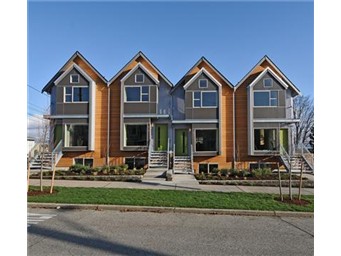
The Brooks and Heinze Team recently sold one of a group of brand new townhomes at the corner of Linden Ave N & 85th (just a couple of blocks west of Hwy 99).

This group of townhomes were all “pre-wired” for solar and wind energy technology. I hope more and more builders will give new homeowners a choice to take advantage of wind and solar energy. Northwest Windpower installed the first Wind Energy Ball in Washington State on a Multi-Family Building. The system is the V100, the smaller of their two models, rated at 500 Watts, which is highly efficient and best suited for lower wind environments, requiring only 3 mph to Start. Expected annual output is between 1600 and 2300 KWh at this location. The ball actually looks more like art. Judge for yourself.

None of the all new owners went for solar but everything is wired and ready to go for that. I met with Solar Goddess aka Aimee Carpenter recently to learn more about solar energy. Aimee is a certified solar design consultant and works for Sunergy Systems in Ballard. I asked Aimee if solar makes sense in the Northwest which is not exactly known for sunshine. Aimee explained that although higher latitudes receive fewer annual hours of sunlight, solar panels operate at greater efficiency in cooler climates making the Northwest an excellent place for solar. In addition, the Northwest has long summer days with many months of high solar hours. Also, solar still works on cloudy days. Interestingly, we receive about 20% more sunlight than Germany annually and yet they are the world’s leader in solar energy production.

There are some great Washington State and Federal government incentive programs available to offset your renewable energy system costs and make your solar electric or hot water system more affordable.

If you would like to learn more about Solar Energy, please contact Aimee directly.

Aimee Carpenter

Solar Design Consultant

4546 Leary Way NW
Seattle, WA 98107

Email: aimeec@sunergysystems.com
Work: 206.297.0086
Cell: 360.961.0712
Fax: 206.784.2605
Web: http://www.sunergysystems.com

Oregon License: CCB # 180276
Washington Licenses: GCL# SUNERSI905DU, ECL# SUNERSI905D4

Or if you like to tweet, find Aimee on Twitter at http://twitter.com/Solar_Goddess

Kerstin G. Brooks
Brooks & Heinze Real Estate Team
www.propertyinseattle.com

Mortgage Interest Rate Myths


The following blog entry is a guest contribution by Virginia Lawson of Cobalt Mortgage in Kirkland, WA.

This may come as a shock to many borrowers, but it’s absolutely true. Mortgage interest rates are not set by the Federal Reserve and, contrary to popular belief, mortgage rates are not directly tied to the yields of US Treasury bills, bonds, or notes – including the 10-year Treasury Note. That’s right. Despite what you might hear in the media, mortgage interest rates are actually set by lending institutions, and are based solely on the performance of mortgage-backed securities.

For years now, the media and inexperienced loan officers everywhere have suggested that the 10-year Treasury Note, a government-backed security, is directly tied to mortgage interest rates, that the two are separated by a specific interval – which is simply not true. The graph on this page, which shows interest rates for 30-year fixed-rate mortgages and the yield for the 10-year Treasury Note for 13 months, clearly demonstrates this fact.

At a quick glance, yes, it’s easy to see why the mistake is made. As you can see, for 11 out of the 13 months recorded in the graph, the yield of the 10-year Treasury Note and interest rates for 30-year fixed-rate mortgages did follow a somewhat similar long-term path, despite obvious short-term divergences. However, take a closer look at the drastic change that occurs from January through March 2008. What’s interesting about this graph is that, during this period, the Federal Reserve had cut interest rates six times, from September 2007, to March 2008, and yet mortgage rates were actually higher in March 2008 than they were a year before. Not only does this demonstrate that the yield of the 10-year Treasury Note is not pegged to mortgage interest rates, it also reveals that mortgage interest rates are not set by the Fed either.

Stop being misled. If you or someone you know is thinking about buying or refinancing a home, give us a call. We’ll give the facts you need to make a truly informed decision.


Virginia Lawson, Senior Mortgage Advisor
Cobalt Mortgage
Phone: (425) 605-3129
License: 510-LO-51808
http://www.virginialawson.com

Three Most Common Ways to Hold Title (in Washington State)


There are many different ways of holding title such as joint tenancy, in a trust, sole, etc.  The three most common ways in Washington are Joint Tenancy with right of survivorship, Tenancy in Common and Community Property:

Joint Tenancy: The main distinguishing characteristic of joint tenancy is the right of survivorship. If one of the joint tenants dies, his interest passes automatically to the surviving party or parties instead of being tied up in lengthy probate proceedings. When two or more people own a property as joint tenants, they own an undivided equal interest in the property.

Tenancy-in-Common: This is so standard a form of ownership for unrelated buyers that it is generally presumed to be the way they hold title if nothing else appears to the contrary. The shares are presumed to be equal unless stated otherwise on the deed, and each of the tenants has equal rights of possession. There is no right of survivorship; each tenant-in-common should note in his will the person or persons to whom his share will pass.

Community Property: This type of ownership is available to married couples in nine states – Arizona, California, Idaho, Louisiana, Nevada, New Mexico, Texas, Washington and Wisconsin. Both husband and wife have an equal right to possess the property during their marriage, and in some states, upon the death of either spouse, the survivor automatically receives half of the community property and the other half passes to the lawful heirs.

Click on the following image to enlarge it and get a more detailed overview of these three most common types of ownership.

This image was provided courtesy of John Monger (Rainier Title – Seattle)

The comparison above was provided for information only. It should not be used to determine how you hold title. We are real estate agents and not attorneys or CPAs; we cannot give legal or tax advice. We strongly recommend that you seek professional counsel from an attorney and/or CPA to determine the legal and tax consequences of how title is vested.

Kerstin G. Brooks
Brooks & Heinze Team
Cell: 206.276.5827
http://www.propertyinseattle.com

Another Home Buyer Tax Credit Extension Granted? Not really, read the fine print …


Congress “extends” First Time Home Buyer Tax Credit deadline to September 30th – well not really. They extended the CLOSING DEADLINE to the end of September for buyers who went under contract before April 30 but this does not mean it is a true extension.

The National Association of Realtors beat their drums loudly enough on the steps of Capital Hill to get Congress to approve an extension of closing deadline to the First Time Homebuyer Tax Credit. So, don’t jump out of your seats ! The tax credit extension is only for those who were already under contract before the previous deadline of April 30th, they now have until September 30th to close and receive the $8000 first time buyer credit. This extension is from a close date of June 30th. The most compelling reason for this extension was do to the high volume of Short Sales that are currently under contract and are not on scheduled to close by the June 30th date. This is because Short Sales require bank approval on the Seller’s side, and most large banks that are being asked to approve Short Sales are simply over inundated with such requests that they are just backed up.

There is one group of buyers who can still take advantage of the tax credit and who did have a true extension and those are members of the military, foreign service and intelligence service. They have another year to take advantage of the credit. For more information about this, see my blog entry at:
https://propertyinseattle.wordpress.com/2010/05/17/special-one-year-homebuyer-tax-credit-extension-for-members-of-the-military-foreign-service-and-intelligence-service/

Kerstin G. Brooks
206.276.5827
Brooks & Heinze Team
http://www.propertyinseattle.com

Federal Way Townhouse for Rent


27924 31 Pl S, Federal Way, WA | Powered by Postlets.

Quality built 3bd/2.5bth Craftsman style townhome in great community near Starlake (Federal Way) for rent at $1495/mo.

$30 application fee. $1500 deposit (can be financed). First month rent.  Available immediately.

9′ ceilings, hardwood floors, tile floors, maple cabinets & trim, and tile countertops. Spacious living room. Oversized dining room off kitchen. Separate laundry. Gas heat, water heater & fireplace.  Two car garage. Lots of storage.

Easy access to I-5 and Valley Freeway. 20 minute commute to downtown, 30 minute commute to military bases (Fort Lewis and McChord), 10 minute commute to airport.

Contact Kerstin for a showing at 206.276.5827.

Kerstin G. Brooks
Brooks & Heinze Team
www.propertyinseattle.com

Special one-year Homebuyer Tax Credit Extension for Members of the Military, Foreign Service and Intelligence Service


Home Buyer Tax Credits Have Expired BUT service members who were on official extended duty outside of the United States for at least 90 days between Jan.1, 2009 and May 1, 2010, may qualify for a one-year extension.)

Special rules for eligibility also apply for members of the foreign service and the intelligence community.

Military, Foreign Service, Intelligence Community

Congress has acknowledged the unique circumstances affecting members of the military, the foreign service and the intelligence community by making the following exceptions that apply to both the $8,000 tax credit for first-time home buyers and the $6,500 tax credit for repeat home buyers.

Exemption From Tax Credit Recapture Rules
•Typically, homes that are sold or that cease to be used as a principal residence within three years of the initial purchase are subject to recapture of the tax credit.
•However, qualified service members who sell or move from a tax credit home within three years of the initial purchase due to official extended duty are exempt from the recapture rule.
Extension of Tax Credit Deadlines
•The home buyer tax credit is available for qualified purchases with a binding sales contract in place on or before April 30, 2010 and closed by June 30, 2010.
•However, for qualified service members who are ordered on a period of official extended duty, these dates are extended for one year. For these home buyers, the tax credit applies to sales with a binding sales contract in place on or before April 30, 2011 and closed by June 30, 2011.
•A person who is forced to return to the U.S. for medical reasons before completing an assignment of at least 90 days of qualified official extended duty outside of the United States may qualify for the one-year extension.
Definitions
•“Qualified service member” means a member of the uniformed services of the U.S military, a member of the Foreign Service of the U.S., or an employee of the intelligence community.
•“Official extended duty” means any period of extended duty outside of the United States for at least 90 days during the period beginning after December 31, 2008 and ending before May 1, 2010.


Kerstin G. Brooks
Brooks & Heinze Team
206.276.5827

Mortgage Credit Certificate


The Mortgage Credit Certificate Program allows qualifying first-time homeowners to claim a federal tax credit of up to 20 percent of their annual mortgage interest paid. Pretty neat!

Following is the reprint of the information provided by the Washington State Housing Finance Commission:

Federal Income Tax Credit for Homebuyers

MCCs are not mortgages… they are tax credits that put extra cash in your pocket each month, so that you can more easily afford a house payment, which means fewer tax dollars will be withheld from your regular paycheck, increasing your take-home pay.

How do I apply?

Applications are accepted on a first-come, first-served basis by a statewide network of lenders.  Your lender will establish all underwriting criteria, including interest rate, down payment requirement, term, fees, points, and closing costs.  Your lender will submit your loan application and notify you as to whether your application is accepted.  It is strongly recommended that you contact a tax professional before applying for an MCC in order to determine the potential benefits an MCC may provide for your specific tax situation.

Who are the Participating Lenders?

Bank of America | Cobalt Mortgage | Cornerstone Mortgage Company | Eagle Home Mortgage | Evergreen Home Loans  | First Rate Mortgage | Golf Savings Bank | Guild Mortgage | HomeStreet Bank | Integra Pacific Mortgage | Metlife Home Loans | Mortgage Advisory Group | Prime Lending | Seattle Metropolitan Credit Union | Sierra Pacific Mortgage | Wallick & Volk | Wells Fargo Home Mortgage

What are the loan types?

MCCs are available with fixed or adjustable rate conventional conforming (i.e., Fannie Mae or Freddie Mac saleable), FHA, VA, Rural Development mortgages.  The Commission’s House Key State Bond Program is not available for use with the MCC Program.

What are the fees?

The nonrefundable MCC fee is $650 and it is collected at the time of loan closing.

What are the program guidelines?

As with any program, there are qualifying rules and regulations.  MCC eligibility requirements include:

New Loans Only
The MCC is available with new purchase loans only. Refinances are not accepted, unless you are replacing some type of short-term bridge financing with a term of 24 months or less.

Income Limits
Borrowers must not exceed these Maximum Annual Income Limits:

County Non-Targeted
1-2 Persons
Non-Targeted
3+ Persons
Targeted
1-2 Persons
Targeted
3+ Persons
Island $75,000 $87,000 $90,000 $95,000
Pierce/San Juan $75,000 $87,000 $75,000 $87,000
King/Snohomish $90,000 $97,000 $90,000 $97,000
All other counties $65,000 $75,000 $75,000 $75,000

Acquisition Cost Limits
Borrowers must meet these property acquisition cost limits. Acquisition cost limits of a single-family residence must not exceed the following:

COUNTY Non-Targeted Targeted
Clark/Island $330,000 $360,000
Jefferson/Pierce/Snohomish $370,000 $395,000
King/San Juan $450,000 $475,000
Kitsap/Whatcom $300,000 $335,000
Skagit $285,000 n/a
All Other Counties $235,000 $285,000

Eligible Properties
Single-family existing homes, new construction, manufactured homes (permanently) affixed or on leased land), and homes located on Native American trust land, located in both Targeted Areas and Non-Targeted Areas.  Check the Commission’s website Targeted Areas page to see if the property is in a Targeted Area.  Note:  Not all counties have Targeted Areas.

Business Use Limits
No more than 15% of the residence may be used for trade or business purposes.

Owner Occupancy
The MCC is valid for the life of the loan, so long as you remain the owner-occupant of the residence.

Homebuyer Education
You must complete a Commission sponsored homebuyer education course providing you with the steps to buying your home.

Recapture Tax
A recapture tax may apply only in the event that –  you sell your home in the first nine years,
and – your income has increased significantly, and – you have a substantial gain on the sale.
IRS Form 8828 explains how the tax is calculated.

What happens if I refinance my loan?  What happens to my current MCC?

If you refinance your property, the MCC may be reissued if completed within one year of refinance and if you qualify under the program guidelines.  The amount on the reissued MCC cannot exceed the outstanding balance of the mortgage prior to refinancing and the certificate credit rate cannot exceed the certificate credit rate specified in the existing certificate.  Further restriction apply.

A $375.00 non-refundable application fee must be included in a reissuance request.

If you have questions about the  Mortgage Credit Certificate (MCC) Program, please email the Brooks & Heinze Team  at info@propertyinseattle.com or email the Washington State Housing Finance Commission at askusHO@wshfc.org.

Kerstin G. Brooks
Brooks & Heinze Team
Cell: 206.276.5827
Email: kerstinbrooks@earthlink.net

Closing costs in the home buying process


Following is a Video from WAHomeowners.com which is a not-for-profit clearinghouse of public information concerning the purchase and ownership of your home.

For more information about closing costs and the home buying and selling process, please contact us.

Kerstin G. Brooks
Brooks & Heinze Team
Skyline Properties, Inc.
http://www.propertyinseattle.com